Barcelona 58%, Madrid 48%: what the viral rent chart measures, and what it doesn't

A chart that's being shared a lot compares rent with take-home pay in Europe's big cities. It puts Barcelona at 58%, Valencia at 57% and Madrid at 48%. The data comes from Numbeo, where users report it themselves, so treat it as a rough picture and not an official statistic. Industry sources point the same way, with higher numbers.
What the chart measures
The chart is by frontpages.eu and uses Numbeo data from the 12 months to 1 October 2026. For every city of over a million people in Eurostat's city statistics, it does one simple sum:
- the rent on a one-bedroom flat outside the city centre,
- divided by average monthly pay after tax.
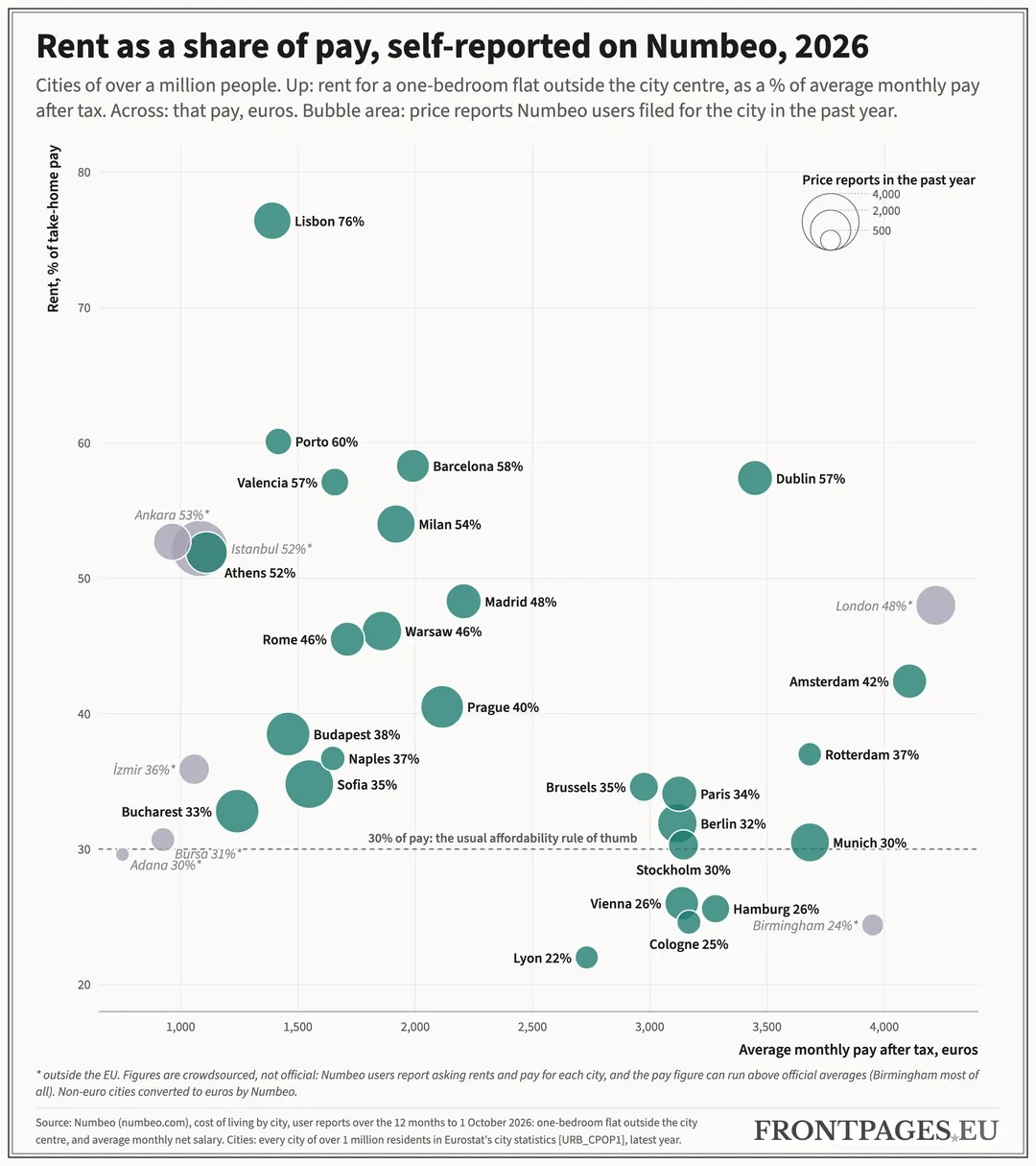
The chart by frontpages.eu, from what Numbeo users report. Grey bubbles are cities outside the EU.
The dotted line is the usual rule of thumb: rent shouldn't be more than 30% of what you take home.
Where Spain lands
| City | Rent, % of take-home pay |
|---|---|
| Lisbon | 76% |
| Porto | 60% |
| Barcelona | 58% |
| Valencia | 57% |
| Dublin | 57% |
| Milan | 54% |
| Madrid | 48% |
| Paris | 34% |
| Berlin | 32% |
| Vienna | 26% |
A selection of cities from the frontpages.eu chart, using Numbeo data.
Barcelona is the third-highest EU city on the chart, behind only Lisbon and Porto. Madrid comes out better for two reasons. On Numbeo, average pay is higher there (about €2.190 against about €2.000 in Barcelona), and the flat outside the centre is a bit cheaper (about €1.070 against about €1.160).
Swap "outside the centre" for "in the centre" and, on today's Numbeo figures, it gets worse: Barcelona goes up to 75%, Valencia to 77% and Madrid to 61%.
Why it needs a grain of salt
- Users report it. Over a year, Barcelona has about 1.380 entries from 250 people, Madrid about 1.570 from 221, and Valencia 982 from 136. That's not many people for a whole city.
- The pay figure can run high. The chart itself warns that Numbeo's pay can sit above official averages. If real pay is lower, the real share is higher.
- Nobody defines "outside the centre". Each user decides where the centre ends.
- It's one bedroom and one salary. If you share costs with someone, your share is different.
Other sources, same story
- Fotocasa and InfoJobs (June 2026): in 2025, renting an 80 m² flat took 50% of the average gross salary in Spain, up from 38% in 2019. In Barcelona it was 76%, and in Madrid 72%. They use gross pay from job ads and a bigger flat, so you can't compare it directly with the chart's 58%.
- Idealista (September 2026): asking rent in Barcelona was €20,1/m², 0,8% lower than a year earlier. In Madrid it was €23,4/m², 4,8% higher. Per square metre, Madrid comes out more expensive than Barcelona, even though Numbeo has its one-bedroom flat cheaper. They're different flats in different areas.
No single number tells the whole story, but they all point the same way: in Spain's big cities, rent takes far more than 30% of pay.
Why this is everywhere right now
On 2 October Congress voted down both housing decrees, which included a 2% cap on rent rises and lease extensions. The next day there were housing protests in several cities. In Madrid, the Sindicato de Inquilinas (tenants' union) put the crowd at 500.000, and the Delegación del Gobierno (central government office) at 70.000.
Update, 8 October 2026: the government approved the decrees again on 6 October, with the 2% cap on rent rises and the lease extensions, pending validation. What changes if you rent.
Work out your own
Take the rent on the flats you're actually looking at and divide it by what you take home each month. That's the number that matters to you, not anyone's average.
Questions
- How much of their pay do people in Barcelona spend on rent?
- On Numbeo's self-reported data, a one-bedroom flat outside the centre costs about 58% of average take-home pay, or about 75% in the centre. Fotocasa and InfoJobs put an 80 m² flat at 76% of average gross salary in 2025.
- And in Madrid?
- About 48% outside the centre and about 61% in the centre on Numbeo. Fotocasa and InfoJobs put it at 72% of gross salary.
- Is Numbeo data reliable?
- It's crowdsourced. Users report rents and pay themselves, and in Barcelona that's about 250 people a year. Use it as a rough guide, not an official statistic.
Sources
- frontpages.eu: Rent as a share of pay, self-reported on Numbeo, 2026
- r/europe: the chart as posted on Reddit, with EU, UK and Turkish cities
- Numbeo: cost of living in Barcelona
- Eurostat: population of cities (URB_CPOP1)
- Euronews: Spaniards now spend half their salary on rent (1 Jun 2026)
- El Debate: rent takes half of tenants' pay (2 Jun 2026)
- Idealista: September 2026 rents (1 Oct 2026)
- El Español: the housing measures that fell in Congress (2 Oct 2026)
- El Diario de Madrid: 500.000 according to the tenants' union, 70.000 according to the Delegación (3 Oct 2026)